

Google Ads has become one of the most powerful advertising platforms in digital marketing. Businesses across industries rely on this tool to reach customers, generate leads, and drive sales. As demand for skilled advertisers grows, so does the need for professionals who understand how to manage and optimize campaigns effectively.
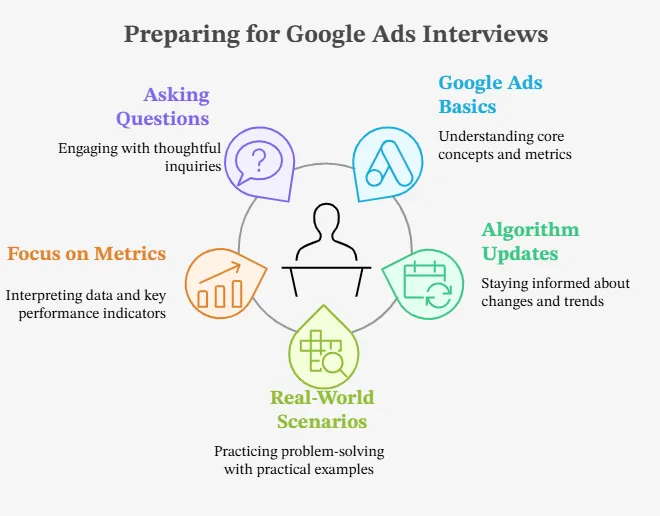
Preparing for a Google Ads job interview requires more than memorization. Success depends on understanding core concepts, demonstrating practical knowledge, and showing the ability to solve real-world problems.
Whether applying for an entry-level position or a senior role, candidates must be ready to answer a wide range of questions covering campaign setup, optimization, tracking, and strategy.
This comprehensive guide covers 100 Google Ads interview questions organized by topic and difficulty level. From basic definitions to advanced troubleshooting scenarios, each section addresses what interviewers commonly ask and what hiring managers look for in responses. The content is designed for freshers entering the field, digital marketing students preparing for placements, and professionals looking to advance their careers.
Basic questions
1. What is Google Ads?
Google Ads is an online advertising platform where businesses pay to display ads on Google search results, websites, videos, and apps. Advertisers bid on keywords to show their ads to relevant audiences.
2. How does Google Ads work?
Google Ads operates on an auction system. Advertisers bid on keywords, and Google determines ad placement based on bid amount, ad quality, and relevance. Advertisers pay only when users click their ads (Pay-Per-Click model).
3. What are the main types of Google Ads campaigns?
The primary campaign types include Search, Display, Video, Shopping, App, and Performance Max.
Each serves different advertising goals and reaches audiences through different Google properties.
4. What is the difference between Google Ads and organic search?
Google Ads are paid placements that appear above or alongside organic results, marked as “Sponsored” or “Ad.”
Organic search results appear based on SEO and content relevance without payment.
5. What is PPC?
PPC stands for Pay-Per-Click, a digital advertising model where advertisers pay each time someone clicks their ad. Google Ads primarily uses this pricing model.
Tip: Always explain why PPC is useful—controlled budget, measurable ROI, and intent-based targeting.
6. What are impressions in Google Ads?
Impressions represent how many times an ad has been displayed to users, regardless of whether they clicked on it.
7. What is CTR in Google Ads?
CTR (Click-Through Rate) is the percentage of people who click on an ad after seeing it. It’s calculated by dividing clicks by impressions and multiplying by 100.
8. What is conversion in Google Ads?
A conversion occurs when a user completes a desired action after clicking an ad, such as making a purchase, filling out a form, or signing up for a newsletter.
9. What is the Google Ads auction?
The Google Ads auction is the process that determines which ads appear for each search query and in what order, based on factors like bid amount, quality score, and ad relevance.
10. What is ad rank?
Ad rank determines the position of an ad on the search results page. It’s calculated using the maximum bid, quality score, ad extensions, and expected impact of extensions and formats.
Google Ads Account Structure Questions
11. What is the structure of a Google Ads account?
The hierarchy follows:
Account → Campaign → Ad Group → Ads and Keywords.
Each level serves a specific organizational purpose and allows for different settings and controls.
12. Why is proper account structure important?
A proper structure enhances Quality Score, budget control, reporting clarity, optimization efficiency, and performance tracking. It allows better targeting and clearer reporting of results.
13. What is a campaign in Google Ads?
A campaign is a set of ad groups that share the same budget, location targeting, bidding strategy, and other settings. Each campaign focuses on a specific advertising goal.
14. What is an ad group?
An ad group contains a set of related keywords and the ads that target those keywords. Ad groups help organize campaigns by theme or product category.
15. How many ad groups should a campaign have?
There’s no fixed number, but campaigns typically contain 5-20 ad groups depending on product variety and targeting needs. Each ad group should focus on a tightly related set of keywords.
16. Can multiple campaigns share the same budget?
No, each campaign has its own budget. However, shared budgets can be created to distribute funds across multiple campaigns automatically.
17. What settings are configured at the campaign level?
Campaign-level settings include budget, bidding strategy, location and language targeting, ad scheduling, networks (search or display), and campaign type.
18. What settings are configured at the ad group level?
Ad group settings include keywords, bids (if not using campaign-level bidding), and the ads themselves. Targeting becomes more specific at this level.
19. Can different ad groups have different bids?
Yes, each ad group can have its own default bid, and individual keywords within ad groups can have custom bids that override the ad group default.
20. What happens if the account structure is poorly organized?
Poor structure leads to wasted budget, difficulty tracking performance, inefficient optimization, and lower quality scores. It makes campaign management time-consuming and ineffective.
Google Ads Campaign Types & Use Cases
21. What are Search campaigns?
Search campaigns display text ads on Google search results when users search for relevant keywords. They’re best for capturing high-intent users actively looking for specific products or services.
22. What are Display campaigns?
Display campaigns show visual banner ads across Google’s Display Network, which includes millions of websites, apps, and Google properties like YouTube and Gmail.
23. When should Display campaigns be used?
Display campaigns work well for brand awareness, remarketing to previous visitors, reaching broad audiences, and visual storytelling, where search intent isn’t as defined.
24. What are Video campaigns?
Video campaigns run video ads on YouTube and across the Display Network. They’re effective for brand building, product demonstrations, and engaging audiences with visual content.
25. What are Shopping campaigns?
Shopping campaigns showcase product images, prices, and merchant information directly in search results. They’re designed specifically for e-commerce businesses selling physical products.
26. What is Performance Max?
Performance Max is an automated campaign type that runs ads across all Google channels (Search, Display, YouTube, Gmail, Discover) using a single campaign with machine learning optimization.
27. When should Shopping campaigns be used?
Shopping campaigns are ideal for online retailers with product feeds who want to display visual product listings directly in search results with pricing and availability.
28. What are App campaigns?
App campaigns promote mobile apps across Google Search, Play Store, YouTube, and Display Network. They focus on driving app installs and in-app actions.
29. What is the difference between Search and Display campaigns?
Search targets users actively searching for specific terms, showing text ads.
Display targets users browsing websites, showing visual ads based on interests, demographics, or remarketing.
30. Can one campaign include both Search and Display?
Older campaign types allowed this, but best practice now separates Search and Display into different campaigns for better control, measurement, and optimization.
Keyword & Match Type Interview Questions
31. What are keyword match types?
Match types control how closely a user’s search query must match a keyword for the ad to appear. The main types are Broad Match, Phrase Match, and Exact Match.
32. What is Broad Match?
Match shows ads for searches related to the keyword, including synonyms, related searches, and variations. It offers the widest reach but less control.
33. What is Phrase Match?
Phrase Match shows ads when searches include the meaning of the keyword, allowing additional words before or after. It’s denoted by quotation marks around the keyword.
34. What is Exact Match?
Exact Match shows ads for searches that have the same meaning or intent as the keyword. It’s denoted by brackets around the keyword and offers the most control.
35. What are negative keywords?
Negative keywords prevent ads from showing for specific search terms. They help eliminate irrelevant traffic and reduce wasted spend on unqualified clicks.
36. Why are negative keywords important?
Negative keywords improve campaign efficiency by filtering out unwanted traffic, increasing CTR, improving quality scores, and ensuringthe budget goes toward qualified prospects.
37. What is the difference between search terms and keywords?
Keywords are terms that advertisers bid on. Search terms are actual queries that users type into Google that trigger ads to appear.
38. What tools help with keyword research?
Google Keyword Planner, Search Terms Report, competitor analysis tools, Google Trends, and third-party platforms like SEMrush and Ahrefs assist with keyword research.
39. How many keywords should an ad group have?
Best practice suggests 5-20 closely related keywords per ad group. Fewer keywords allow a tighter thematic focus and more relevant ad copy.
40. Can the same keyword appear in multiple ad groups?
While technically possible, this creates internal competition and makes performance tracking difficult. Each keyword should generally appear in only one ad group per campaign.
Bidding Strategy & Budget Questions
41. What is CPC?
CPC (Cost-Per-Click) is the amount an advertiser pays each time someone clicks their ad. It can be set manually or determined automatically by Google.
42. What is CPA?
CPA (Cost-Per-Acquisition) is the average cost to acquire one conversion. It’s calculated by dividing the total cost by total conversions.
43. What is ROAS?
ROAS (Return on Ad Spend) measures revenue generated for every dollar spent on advertising. It’s calculated by dividing revenue by ad spend.
44. What is manual bidding?
Manual bidding allows advertisers to set maximum CPC bids for keywords or ad groups. It provides complete control but requires ongoing management and optimization.
45. What is automated bidding?
Automated bidding uses Google’s machine learning to automatically adjust bids based on the likelihood of achieving specified goals like conversions or target ROAS.
46. What are Smart Bidding strategies?
Smart Bidding includes Target CPA, Target ROAS, Maximize Conversions, and Maximize Conversion Value. These strategies use machine learning and auction-time signals for optimization.
47. What is the difference between a daily budget and a lifetime budget?
Daily budget sets the average amount to spend per day. Google Ads doesn’t offer lifetime budgets; campaigns run continuously until paused or the daily budget is changed.
48. Can actual daily spend exceed the daily budget?
Yes, Google may spend up to twice the daily budget on high-traffic days, but monthly spend won’t exceed the daily budget multiplied by average days per month (30.4).
49. What is Target CPA bidding?
Cost-Per-Acquisition—the cost to generate one conversion. Target CPA automatically sets bids to get as many conversions as possible at the target cost-per-acquisition specified by the advertiser.
50. What is Maximize Clicks bidding?
Maximize Clicks automatically sets bids to get as many clicks as possible within the budget. It’s useful for driving traffic, but doesn’t optimize for conversions.
Ad Copy & Quality Score Questions
51. What is Quality Score?
Quality Score is a 1-10 rating that measures the quality and relevance of keywords, ads, and landing pages. Higher scores lead to better ad positions and lower costs.
52. What factors affect Quality Score?
The three main factors are expected CTR, ad relevance, and landing page experience. Each component is rated as above average, average, or below average.
53. Why does Quality Score matter?
Higher Quality Scores result in lower CPCs, better ad positions, and eligibility for ad extensions. It directly impacts campaign profitability and performance.
54. How can Quality Score be improved?
Improve Quality Score by increasing ad relevance to keywords, improving landing page experience, writing compelling ad copy, adding relevant extensions, and organizing campaigns tightly.
55. What are Responsive Search Ads?
Responsive Search Ads allow advertisers to provide multiple headlines and descriptions. Google automatically tests combinations and shows the best-performing versions.
56. How many headlines and descriptions can Responsive Search Ads have?
Advertisers can provide up to 15 headlines and 4 descriptions. Google will show up to 3 headlines and 2 descriptions in any ad combination.
57. What makes effective ad copy?
Effective ad copy includes the target keyword, a clear value proposition, a strong call-to-action, relevant extensions, and alignment with landing page content.
58. What are ad extensions?
Ad extensions add additional information to ads, such as phone numbers, location, additional links, prices, or promotions. They increase ad visibility and CTR.
59. Do ad extensions cost extra?
Ad extensions themselves are free. Advertisers only pay when someone clicks on the extension, typically at the same CPC as a regular ad click.
60. What is ad relevance?
Ad relevance measures how closely the ad copy matches the intent behind a user’s search query. Higher relevance improves Quality Score and campaign performance.
Conversion Tracking & Measurement
61. What is a conversion?
It is a valuable user action that advertisers want to track, such as purchases, form submissions, phone calls, or newsletter signups.
62. How are conversions tracked in Google Ads?
Conversions are tracked using conversion tracking tags (code snippets) placed on conversion pages or through imported goals from Google Analytics.
63. What is a conversion window?
The conversion window is the period after an ad click during which conversions are counted. Standard windows are 30 days for clicks and 1 day for views.
64. What is the difference between Google Ads and Google Analytics tracking?
Google Ads uses last-click attribution by default, but advertisers can now use data-driven attribution when sufficient data is available.
65. What are micro-conversions?
Micro-conversions are smaller actions that indicate user engagement but aren’t primary goals, such as video views, page scrolls, or add to cart.
66. What is the conversion rate?
Conversion rate is the percentage of clicks that result in conversions, calculated by dividing conversions by clicks and multiplying by 100. Example:(Conversions divided by clicks × 100)
67. Can conversions be imported from
(Conversions divided by clicks × 100)
67. Can conversions be imported from Google Analytics?
Yes, Google Analytics goals and transactions can be imported into Google Ads as conversions for bidding and reporting purposes.
68. What is view-through conversion?
A view-through conversion occurs when someone sees but doesn’t click a display or video ad, then later converts through another channel within the specified window.
69. How can conversion tracking be verified?
Conversion tracking can be verified using Google Tag Assistant, testing conversion actions manually, checking the “Status” column in conversion settings, or reviewing recent conversion data.
70. What is the conversion value?
Conversion value assigns a monetary amount to each conversion, allowing measurement of total revenue or value generated by campaigns rather than just conversion volume.
Optimization & Performance Questions
71. How can a campaign be optimized?
Optimization involves analyzing performance data, adjusting bids, refining keywords, improving ad copy, testing landing pages, adding negative keywords, and adjusting targeting settings.
72. How can CPC be reduced?
Reduce CPC by improving Quality Score, using exact match keywords, adding negative keywords, lowering bids strategically, improving ad relevance, and enhancing landing page experience.
73. How can CTR be increased?
Increase CTR by writing compelling ad copy, using relevant keywords in headlines, adding ad extensions, improving ad relevance, testing different messages, and targeting qualified audiences.
74. How can Quality Score be improved quickly?
Focus on ad relevance first by ensuring tight keyword-ad-landing page alignment, then improve expected CTR through compelling copy, and finally enhance landing page experience.
75. What is A/B testing in Google Ads?
A/B testing involves running multiple ad variations simultaneously to determine which performs better based on metrics like CTR, conversion rate, or CPA.
76. How long should A/B tests run?
Tests should run until statistically significant results are achieved, typically requiring at least 100 conversions or several weeks of data, whichever comes first.
77. What metrics indicate poor campaign performance?
Low CTR, high CPC, low Quality Score, high bounce rate, low conversion rate, and poor ROAS all indicate performance issues requiring attention.
78. How can the conversion rate be improved?
Improve conversion rate by optimizing landing pages, ensuring message match between ads and landing pages, simplifying conversion forms, improving page speed, and targeting qualified audiences.
79. What is the search terms report used for?
The search terms report shows actual queries that triggered ads. It’s used to find new keyword opportunities and identify irrelevant terms to add as negatives.
80. How often should campaigns be optimized?
Regular monitoring should occur weekly, with minor adjustments made as needed. Major changes should be made less frequently (bi-weekly or monthly) to allow data accumulation.
Troubleshooting & Practical Scenario Questions
81. Why might ads not be showing?
Common reasons include low bids, low Quality Score, disapproved ads, exhausted budget, restrictive targeting, policy violations, or the account being suspended.
82. What causes high impressions but low clicks?
This typically indicates poor ad relevance, weak ad copy, unattractive offers, or the ads appearing for irrelevant searches due to broad match keywords.
83. Why might the budget be spent too quickly?
Budget exhaustion happens when bids are too high, keywords are too broad, no negative keywords exist, or the daily budget is insufficient for the traffic volume.
84. What causes low conversions despite high traffic?
Issues include poor landing page experience, weak offers, misaligned targeting, technical problems on the website, or tracking implementation errors.
85. How can ad disapprovals be resolved?
Review the disapproval reason, correct the policy violation (often related to prohibited content, misleading claims, or destination issues), and resubmit the ad for review.
86. What if the Quality Score is consistently low?
Reorganize campaigns with tighter keyword groupings, rewrite ad copy to match search intent, improve landing page relevance and speed, and consider switching to exact match keywords.
87. Why might conversion tracking not work?
Common issues include incorrect tag placement, missing tags, tag firing errors, browser cookie settings, using the wrong conversion ID, or conflicts with other scripts.
88. How should seasonality be handled?
Adjust budgets during peak seasons, create seasonal campaigns with specific messaging, use seasonal keywords, and utilize bid adjustments to capitalize on high-demand periods.
89. What if competitors are bidding on brand names?
Create branded campaigns with high bids, use exact match keywords, write strong ad copy emphasizing official status, and consider legal action if trademark infringement occurs.
90. How can click fraud be identified and prevented?
Monitor for unusual click patterns, high clicks with no conversions from specific IPs, and use Google’s automatic invalid click detection. Report suspicious activity to Google.
Advanced & Manager-Level Questions
91. How should campaigns be scaled?
Scale by gradually increasing budgets, expanding to new geographies, adding keyword variations, testing new campaign types, and using automated bidding once sufficient conversion data exists.
92. How should large budgets be managed?
Large budgets require sophisticated tracking, multiple campaigns for testing, automated rules for efficiency, regular performance reviews, and portfolio-level bid strategies.
93. What should client reports include?
Reports should cover key metrics (impressions, clicks, CTR, conversions, CPA, ROAS), performance trends, insights and recommendations, and progress toward agreed-upon goals.
94. How can Google Ads scripts help?
Google Ads scripts automate repetitive tasks such as bid adjustments, pausing underperforming keywords, alert generation, and bulk changes across multiple campaigns.
95. What is Performance Max best used for?
Performance Max works well for advertisers with clear conversion goals, quality creative assets, and sufficient conversion volume who want to maximize reach across all Google properties.
96. How should multi-channel attribution be approached?
Understand that Google Ads shows last-click data by default. Consider importing Google Analytics data, using data-driven attribution models, and analyzing the full customer journey.
97. What advanced audience targeting options exist?
Advanced options include custom intent audiences, affinity audiences, in-market audiences, similar audiences, customer match, and combined audience segments.
98. How should competitive markets be approached?
Focus on Quality Score to reduce CPCs, target long-tail keywords, emphasize unique value propositions, use ad extensions aggressively, and consider alternative campaign types like Shopping or Display.
99. What is account-level automation?
Account-level automation includes automated rules, scripts, Smart Bidding strategies, dynamic search ads, and responsive ads that reduce manual management requirements.
100. How can Google Ads integrate with other marketing channels?
Integrate through remarketing lists from website visitors, customer match from email lists, offline conversion imports, CRM data synchronization, and coordinating messaging across channels.
Google Ads Interview Tips
Answering interview questions confidently requires more than knowing definitions. Interviewers look for practical understanding and problem-solving ability.
Demonstrate practical knowledge:
When answering, reference specific examples or scenarios. Instead of just defining Quality Score, explain how it was improved in a real or hypothetical campaign.
Show strategic thinking:
Connect tactical knowledge to business goals. Explain not just what a feature does, but when and why it should be used.
Admit knowledge gaps honestly:
If unfamiliar with a topic, acknowledge it honestly and explain the approach to finding the answer. This shows integrity and resourcefulness.
Ask clarifying questions:
For scenario-based questions, ask for additional context. This demonstrates thoughtful analysis rather than rushing to answers.
Avoid common mistakes:
Don’t memorize answers verbatim, don’t claim expertise in areas lacking experience, and don’t focus solely on theory without practical application.
Prepare questions for interviewers:
Ask about team structure, typical client challenges, account management processes, and opportunities for certification or training.
Understand the role requirements:
Entry-level positions focus on execution and basic optimization. Manager roles require strategic thinking, client management, and team leadership capabilities.
FAQs
Is Google Ads easy to learn?
Google Ads basics can be learned in a few weeks, but mastering optimization, strategy, and advanced features takes months of hands-on practice with real campaigns.
Can freshers get Google Ads jobs?
Yes, many agencies and companies hire freshers for junior positions. Google Ads certification, personal project experience, and internships significantly improve hiring chances.
How long does it take to master Google Ads?
Developing proficiency typically takes 6-12 months of active campaign management. True mastery comes from years of experience across different industries and budgets.
Is Google Ads certification necessary for jobs?
While not always required, Google Ads certification demonstrates foundational knowledge and commitment. Many employers prefer or require certification for advertising roles.
What salary can Google Ads specialists expect?
Salaries vary by location and experience. Entry-level positions typically start at $35,000-$50,000 annually, while experienced specialists can earn $60,000-$100,000 or more.
How important is hands-on experience?
Hands-on experience is crucial. Theoretical knowledge helps in interviews, but employers value candidates who can demonstrate results from managing actual campaigns.
Conclusion
Preparing for Google Ads job interview questions requires understanding both fundamental concepts and practical applications. This guide covers 100 essential questions across all difficulty levels and campaign aspects.
Success in interviews comes from combining theoretical knowledge with the ability to explain how concepts apply to real business challenges. Practice answering these questions, work on actual campaigns when possible, and pursue Google Ads certification to strengthen credentials.
The digital advertising field continues to grow, creating opportunities for skilled professionals. Those who invest time in thorough preparation and continuous learning position themselves for successful careers in Google Ads management.
Bookmark this resource for reference during interview preparation. Share it with others preparing for similar roles. Most importantly, apply this knowledge in practice to build the hands-on experience that separates qualified candidates from exceptional ones.